




About
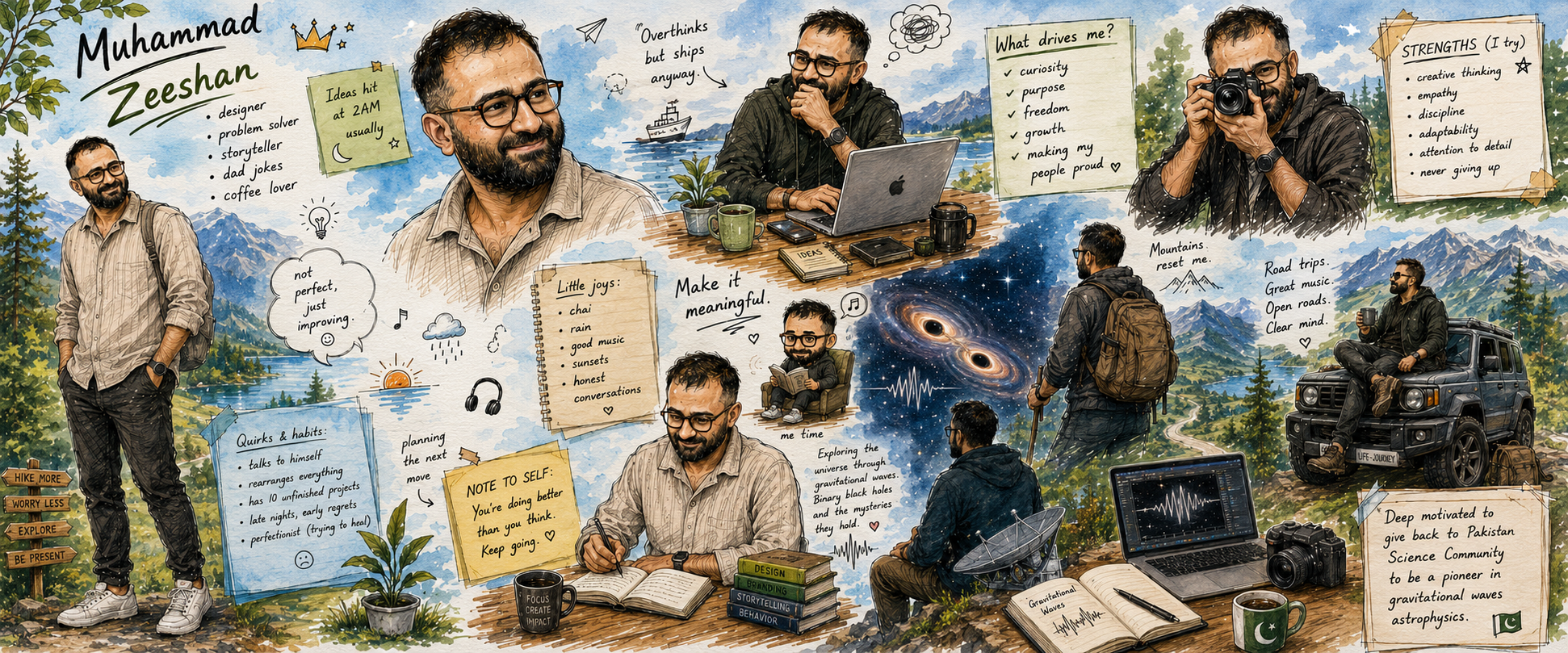
I am a member of the LIGO Scientific Collaboration and a Fulbright PhD Scholar in Astrophysical Sciences and Technology (AST) at Rochester Institute of Technology (RIT), working under the supervision of Prof. Richard O'Shaughnessy. My research focuses on population inference of compact binaries (binary black holes and binary neutron stars), with an emphasis on eccentricity using gravitational-wave data analysis. I lead the development of GWKokab, a JAX-based computational framework for efficient and flexible population inference for sub-population studies including eccentricity.
I have authored multiple peer-reviewed publications and regularly present my work at major international venues such as (ICTP, IAS, APS, AAS, and LVK). I have also mentored undergraduate students to date through research projects in astrophysics.
Before starting my PhD at RIT, I served as a lecturer at the University of Central Punjab for two years, where I taught Calculus and Analytical Geometry, Special Relativity, and General Relativity to undergrad students. I have completed two master's degrees: first MS Mathematics from COMSATS University, Pakistan and second MS Astrophysics from RIT, USA.
You might find it interesting to read some of my publications, or reach out to me via LinkedIn or email (m.zeeshan5885@gmail.com).
Research Interests
Far away in the universe, pairs of black holes and neutron stars orbit each other for millions or even billions of years. As they spiral closer together and finally merge, they shake the fabric of spacetime and produce gravitational waves. These waves travel across the universe carrying information about the objects that created them, such as their masses, spins, distances, and orbital eccentricity.
The LIGO detectors are a remarkable achievement of science and engineering: they can measure incredibly tiny changes in length caused by passing gravitational waves. Once LIGO detects a signal, we use Bayesian inference and gravitational-wave data analysis to estimate the properties of each individual event. For example, we ask: how massive were the two black holes, how fast were they spinning, and did they merge in a nearly circular orbit or in an eccentric one?
My research takes the next step: instead of studying only one event at a time, I combine information from many detected events to understand the population as a whole. This is called population inference. I am especially interested in orbital eccentricity, because eccentric mergers can leave distinct signatures of dynamical formation, where compact objects meet and merge in dense environments such as star clusters. Through this work, I aim to understand how compact binaries form, evolve, and merge across the universe. Students and collaborators interested in Bayesian inference, Python programming, statistics, astrophysics, gravitational-wave data analysis, or scientific computing are very welcome to reach out.
News
| July 2026 | | New Paper: Our paper “Assessing the waveform systematics” is now available on arXiv. |
| July 2026 | | New Paper: Our paper “Uncovering Hierarchical Sub-Population of Binary Black Holes” is now available on arXiv. |
| May 2026 | | Proud Moment: My student Meesum Qazalbash got fully funded admission in AST PhD Program at RIT, NY, USA. | April 2026 | | Publication: Our most waited paper has been published in PRD, Details. |
| March 2026 | | Oral Presentation: APS Global Physics Summit, Denver, Colorado, USA. |
| January 2026 | | Oral Presentation: American Astronomical Society (AAS), Arizona, USA. |
| July 2025 | | Poster Presentation: Institute for Advanced Study (IAS), Princeton, NJ, USA. |
| February 2024 | | Invited Speaker: International Conference on Relativistic Astrophysics and Cosmology, Lahore, Pakistan. |
| March 2023 | | Participant: LIGO–Virgo–KAGRA (LVK) Annual March Meeting, Louisiana State University, USA. |
More updates coming soon.
Selected Recent Publications
- Muhammad Zeeshan, Richard O'Shaughnessy, Natalie Malagon, “Population Properties of Binary Black Holes with Eccentricity”. Accepted in Physical Review D (arXiv:2602.11030).
- Meesum Qazalbash, Muhammad Zeeshan, Richard O'Shaughnessy, “An Implementation to Identify the Properties of Multiple Population of Gravitational Wave Sources”. Physical Review D 113, 103003 (2026). (arXiv:2509.13638).
- Muhammad Zeeshan, Richard O'Shaughnessy, “Eccentricity matters: Impact of eccentricity on inferred binary black hole populations”. Physical Review D 110, 063009 (2024). (arXiv:2404.08185).
See my CV and Google Scholar for the full publication list.
Mentorship
I supervise and co-supervise undergraduate researchers in gravitational-wave astrophysics and cosmology, focusing on population inference, Bayesian methods, and reproducible scientific computing.
-
Co-Mentor — NSF Research Experience for Undergraduates (REU) (Summer 2025, Rochester Institute of Technology, Rochester, NY, USA)
- Student: Sophiya Mehra
- Project: Population Inference Enhanced by Analytical Likelihood (led to a publication)
- Mentor — Independent Research (2023–current, Habib University, Karachi, Pakistan)
- Students: Eiman Maqsood; Amna Iftikhar; Iqra Nadeem
- Project: Contribution of Collisional Matter in Modified Theories of Gravity
Teaching Experience
Teaching experience across undergraduate physics and mathematics, including graduate teaching assistantships and lecturer appointments.
-
Graduate Teaching Assistant, Rochester Institute of Technology (RIT) — Rochester, NY, USA (Jan 2022–Aug 2025)
- Supported instruction through recitations/tutorial sessions, grading, and student mentoring.
- Courses: College Physics I–II; Modern Physics; Stellar Astrophysics.
-
Lecturer (Full-Time), University of Central Punjab (UCP) — Lahore, Pakistan (Mar 2020–Aug 2021)
- Courses: Calculus and Analytical Geometry; Pre-Calculus; Special Relativity; General Relativity.
- Designed tutorials and assessments; held office hours and supported students’ exam preparation.
-
Visiting Lecturer, University of Education — Lahore, Pakistan (Aug 2019–Jan 2020)
- Course: Calculus I.
-
Visiting Lecturer, University of Central Punjab (UCP) — Lahore, Pakistan (Mar 2019–Mar 2020)
- Course: Calculus and Analytical Geometry.
Awards
- Steven M. Wear Endowed Graduate Fellowship — Won the award for the final year of PhD.
- Fulbright PhD Scholarship — Fully funded PhD scholarship for graduate study in the United States.
- Graduate Funding (RIT) — Graduate support as 50% tuition fee award in Astrophysical Sciences and Technology.
- PEEF Merit-based Support — Fully Funded academic support for master’s studies and research training (Pakistan/USA).